Note: For restaurants and bars click here.
We are getting married inVila Nova de Gaia which is literally on the other side of the river (2mn walk to go from one to the other. Vila Nova de Gaia, or simply Gaia is a city and a municipality in Porto District in Norte Region, Portugal. It is located south of the city of Porto on the other side of the Douro River.
Located along the Douro river estuary in Northern Portugal, Porto is one of the oldest European centres, and its historical core was proclaimed a World Heritage Site by UNESCO in 1996. The western part of its urban area extends to the coastline of the Atlantic Ocean. Its settlement dates back many centuries, when it was an outpost of the Roman Empire. Its combined Celtic-Latin name, Portus Cale, has been referred to as the origin of the name “Portugal”, based on transliteration and oral evolution from Latin.
One of Portugal’s internationally famous exports, port wine, is named after Porto, since the metropolitan area, and in particular the cellars of Vila Nova de Gaia, were responsible for the packaging, transport and export of the fortified wine. In 2014 and 2017, Porto was elected The Best European Destination by the Best European Destinations Agency.
We have put a selection of very few things that are great to do if you’re coming longer than the weekend:
2 days Itinerary recommended: http://visitportoandnorth.travel/Blog/Weekend-break-in-Porto-a-two-day-itinerary
1 day in Porto: http://onedayitinerary.com/one-day-in-porto-itinerary/
Walk in the Old Porto – Can’t miss: Take walk in the old Porto and don’t be scared to explore. From Azulejos and tiles to graffiti… the old city reveals treasures and surprises at every corner.
Fado: If you are here on Wednesday, book a table for diner at “Taberna do Cais das Pedras ” . It is very small cosy place where food and drinks are cheap, traditional and… absolutely amazing. On top of it, on Wednesday, you can enjoy traditional Fado with local singers and musiciens who always end up in total improvisation but so much talent. You’re here on Wednesday, really don’t miss it (but book because it’s a small place and always full): https://www.facebook.com/groups/316357988380342/about/
Douro and vineyards: the old train is charming, but we recommend to book a boat tour if you’re short on time or rent a car and explore it your self. These reaches of the Douro have a microclimate allowing for cultivation of olives, almonds, and especially grapes, which are important for making the famous Port wine. The region around Pinhão and São João da Pesqueira is considered to be the centre of Port wine, with its quintas (or farms/estates) that extend along the steep slopes of the river valleys. You can stop in any quinta for tasting but it offers as well an impressive landscape.
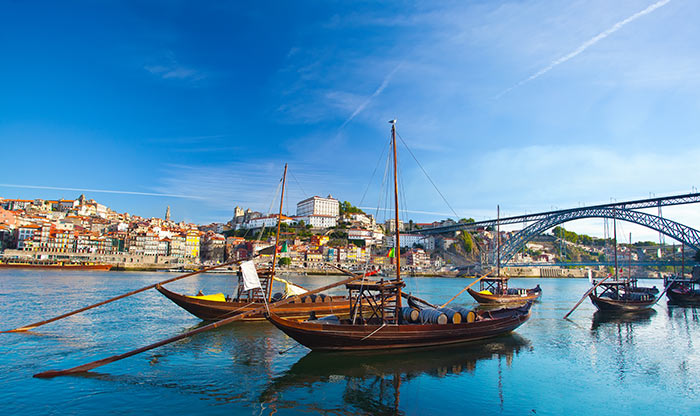
The river side (both Porto and Gaia) and the bridge Ponte de Dom Luis I: The Dom Luís I Bridge (Portuguese: Ponte D. Luís I) is a double-deck metal arch bridge that spans the River Douro between the cities of Porto and Vila Nova de Gaia in Portugal. The project was conducted by Gustave Eiffel ‘s student and it’s a architectural treasure. As well , the all river side is a relaxed area, it is beautiful and always animated. You will be able to sea as well the old boats which were transporting the wine from quintas to Vila Nova de Gaia. Today, they are not in use but translate a all old tradition.
Have sea food by the beach: Lots of guides will advice you to go to Foz, which is more expensive and less charming than the beach on Gaia side. For sea food, we recommend to stop at Mar A Vista (No need booking): http://www.mar-vista.net/
Experience Livraria Lello :This bookstore is one of the most beautiful in the world and has become extra famous as one of JK Rowling’s favorite haunts when she lived in Porto (and began developing the Harry Potter series). There is no doubt that the Livraria Lello & Irmão, which has been in business since 1906, is one of Porto’s most popular and busiest landmarks; there is even a cover charge to enter. Centrally located, near the locals’ favorite Piolho Café and a block from Igreja do Carmo, it’s easy to find, but be prepared to stand in a line to enter.
Tour as many architectural masterpieces as possible
Porto is a beautifully historic city with plenty of centuries-old buildings; the churches and Livraria Lello & Irmão, while amazing to see, aren’t the only ones worth visiting. While walking around, make a few special stops to see the stunning Palácio da Bolsa, the artistic Café Majestic, and the breathtaking Torre dos Clérigos. If you feel like wandering further (or driving/taking public transport), visit the Serralves Museum of Contemporary Art, one of the most important contemporary art museums in Portugal and located on the beautiful Serralves Estate.
Palácio Da Bolsa :The Palácio da Bolsa (Stock Exchange Palace) is a historical building in Porto, Portugal. The palace was built in the 19th century by the city’s Commercial Association (Associação Comercial) in Neoclassical style. It is located in the Infante D. Henrique Square in the historical centre of Porto, designated World Heritage Site by UNESCO. The interior of the Palace, only finished in 1910, was magnificently decorated by several artists. The central courtyard (Nations’ Courtyard – Pátio das Nações) is covered by a large metallic, octagonal dome with glass panels, designed by Tomás Soler and built after 1880. The lower part of the dome is decorated with the painted coats-of-arms of Portugal and the countries with which Portugal had commercial relations in the 19th century. To the back of the courtyard, a sumptuous stairway, built in 1868 by Gonçalves e Sousa, leads to the upper storeys and is adorned with busts by celebrated sculptors António Soares dos Reis and António Teixeira Lopes. The ceiling frescoes were painted by António Ramalho. Several rooms of the Palace – Tribunal Room, Assembly Room, Golden Room – display furniture by José Marques da Silva, allegoric paintings by José Maria Veloso Salgado and João Marques de Oliveira, sculptures by Teixeira Lopes and many other works of art. The highlight of the Palace is, however, the Arab Room, built between 1862 and 1880 by Gonçalves e Sousa. The room is decorated in the exotic Moorish Revival style, fashionable in the 19th century, and is used as reception hall for personalities and heads of state visiting Porto.
World of Discoveries – Museu Interativo & Parque Tematico: this museum will explain the history of Portugal from a navigation point. Everywhere the great navigators went and what they brought with them. It is interactive and very interesting to understand the history of Portugal. Highly recommended if you have kids as well.
There is much more to do and you should have a look to http://portoportugalguide.com/index.html
If you are planning to stay longer to visit Portugal, spend a bit more time in Douro if you love nature and wine. Lisbonne has a lot to offer and it’s only 3h away by train. If you’re heading to Lisbonne, don’t miss Sintra with its magnificent castle and the Quinta da Regaleira is an estate located near the historic center of Sintra, Portugal. It is classified as a World Heritage Site by UNESCO within the “Cultural Landscape of Sintra”. Along with the other palaces in the area such as the Quinta do Relógio, Pena, Monserrate and Seteais palaces, it is considered one of the principal tourist attractions of Sintra. The property consists of a romantic palace and chapel, and a luxurious park that features lakes, grottoes, wells, benches, fountains, and a vast array of exquisite constructions. The palace is also known as “The Palace of Monteiro the Millionaire”, which is based on the nickname of its best known former owner, António Augusto Carvalho Monteiro. This last site includes as well the impressive Escalera-pozo.